
Chefchaouen day trip from Fès with your own driver
Chefchaouen is the blue town in the Rif mountains, about 195 km north of Fès. On this day trip a private car picks you up at your riad or hotel in Fès at 08:00. You reach Chefchaouen at about 11:30 and have the afternoon in the blue medina. The driver waits for you, and you are back in Fès between 19:30 and 20:00. Damask is a private driver service. You pay one fixed price for the whole car, not per person, and we send it to you on WhatsApp before the trip.
At a glance
- About 195 km and about 4 hours each way, with a coffee stop at Ouezzane.
- Four to four and a half hours in Chefchaouen, at your own pace.
- Your driver waits all day and drives you back the same evening.
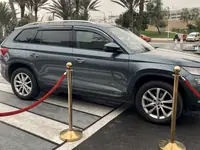
- An English- or French-speaking driver, in a private air-conditioned car.
- One fixed price for the car, sent on WhatsApp. We usually reply within the hour.
On this page
- Is Chefchaouen worth a day trip from Fès?
- The day, hour by hour
- What is included, and what is not
- Ways to get from Fès to Chefchaouen and back in a day
- The road from Fès: what to expect
- What to see in Chefchaouen in four hours
- Ras El Maa and the Spanish Mosque viewpoint
- Why is Chefchaouen blue?
- Chefchaouen or the Akchour waterfalls?
- Best time of year for the trip
- What to wear
- Where and what to eat
- Tips for your day trip
- What the day costs
- How to book your day trip
- Frequently asked questions
Is Chefchaouen worth a day trip from Fès?
Yes, if you have only one free day and want to see the blue town. It is a long day, though, and you should know that before you book. The drive is about 4 hours each way, so you spend about 8 hours in the car for about four hours in town. Our Fès to Chefchaouen transfer page says the same thing: a night in Chefchaouen gives you more for the same drive.
A day trip makes sense when:
- your plans are built around Fès and you have one day to spare;
- you do not want to move your luggage or change riads;
- you are happy to walk the medina, take photos and have lunch, without the sunset or the waterfalls;
- you are fine with a long day, or you sleep well in a car.
A night is better when:
- you want the town early in the morning or in the evening, when the day visitors have gone;
- you want the sunset from the Spanish Mosque;
- you want to add the Akchour waterfalls, which take half a day on their own;
- you are going north anyway, to Tangier or the ferry. Then a one-way transfer with a night in Chefchaouen beats a return trip to Fès.
If you are not sure, tell us your dates on WhatsApp. We will tell you honestly which plan fits.
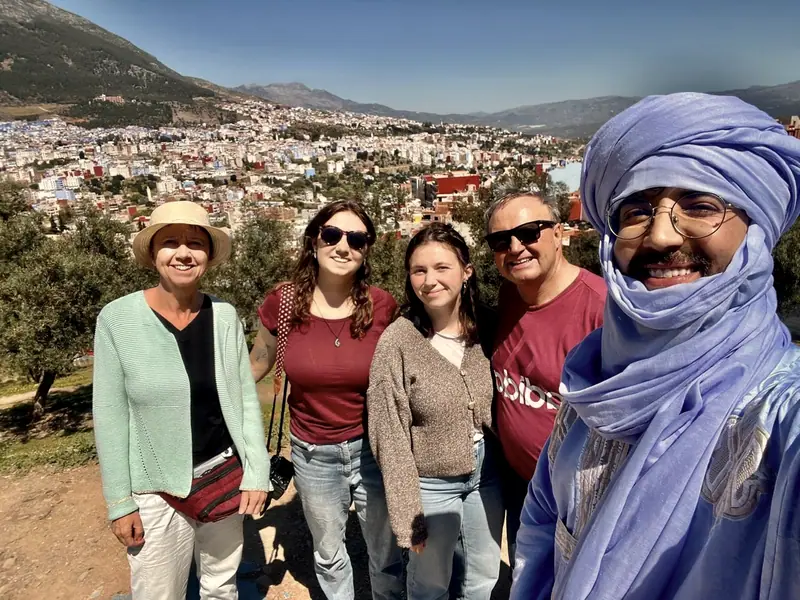
The day, hour by hour
These are the times we suggest. It is your car, so we can move them. Leaving earlier gives you more time in town, and leaving later brings you back later.
| Time | What happens |
|---|---|
| 08:00 | Pickup at your riad or hotel in Fès |
| About 10:00 | Coffee stop at Ouezzane, on the road, no detour |
| 11:30 | Arrival in Chefchaouen, at the edge of the medina |
| 11:30 to 13:30 | Outa el Hammam square, the Kasbah, the blue lanes |
| About 13:30 | Lunch, at a place of your choice |
| 14:30 to 16:00 | Ras El Maa, the upper lanes, a viewpoint |
| 16:00 | You meet your driver for the drive back |
| 19:30 to 20:00 | Drop-off at your riad or hotel in Fès |
Leaving Fès. Cars cannot enter the old medina of Fès. If your riad is inside, your driver meets you at the nearest gate or car park. Many riads send someone to walk you there. In the Ville Nouvelle, the driver comes to your hotel door. Give us the name of your riad when you book and we tell you where to meet.
On the road. Ouezzane, a hill town about 128 km from Fès, is the natural halfway stop. After Ouezzane the road climbs into the Rif and the bends begin.
In Chefchaouen. Cars stop at the edge of the medina, which is a pedestrian zone of stairs and lanes. Your driver parks there, gives you the meeting point and a phone number, and waits for you. You go where you like, and you can come back to the car at any time.
The drive back. You leave at about 16:00, or at the time you agree with your driver. On a winter evening the last part of the drive is in the dark. Your driver knows the road.
What is included, and what is not
Included:
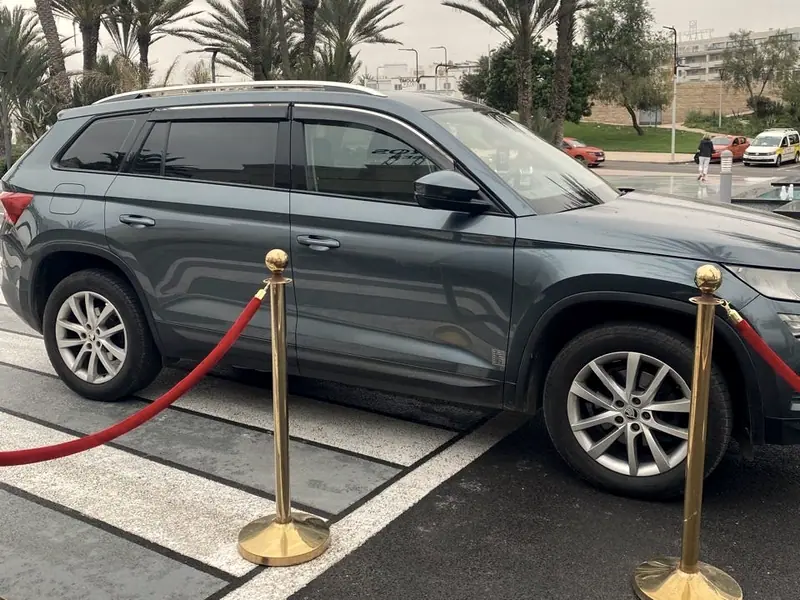
- a private air-conditioned car for your group only;
- an English- or French-speaking driver, who waits for you all day;
- pickup and drop-off at your riad or hotel in Fès;
- fuel, tolls and parking;
- water on board;
- child seats, free on request: tell us each child's age.
Not included:
- lunch and drinks;
- entry fees, such as the Kasbah museum;
- a local guide in Chefchaouen, which we can arrange on request;
- personal expenses and tips.
Your driver is a driver, not a licensed guide. If you want someone to explain the history as you walk the medina, ask for a local guide when you book.
Ways to get from Fès to Chefchaouen and back in a day
There is no train to Chefchaouen. The railway does not reach the town. Here is how the options compare for a return trip in one day.
| Private car (Damask) | Small-group tour | CTM coach | |
|---|---|---|---|
| Who is on board | Only your group | Other travellers | The public |
| Pickup | Your riad or hotel | Usually a set point or your hotel | The coach station |
| Departure time | You choose | Fixed | 08:00 out, set times back |
| Time in Chefchaouen | About 4 to 4.5 h | Set by the tour | Under 3 h |
| Stops on the way | When you ask | The tour's stops | Ouezzane |
| Price | One price for the car | Per person | 145 MAD per person each way |
A private car is the most comfortable way and the most flexible. You leave at the time you choose and stop when you need to. You stay as long as you like, within the day. For three people or more, one price for the car often compares well with tickets bought per head.
A small-group tour fills a minibus with travellers from different hotels. It costs less for one person, and someone else plans the day. You follow the group's schedule, and the pickups and other people's stops take time.
The CTM coach is the cheapest way for one or two people. In November 2026, CTM sold four direct coaches a day from Fès. The 08:00 reached Chefchaouen at 12:10. Coming back, coaches left at 10:15, 13:00, 15:00 and 18:45, and took 4 h 30 to 5 h. For a same-day return you would take the 08:00 out and the 15:00 back. That leaves you less than three hours in town, and you get back to Fès at about 19:30 or later. Then add a taxi to the station at each end. The 18:45 coach gets you back late at night. Times and fares can change, so check CTM for your date.
A grand taxi also runs in this part of Morocco, shared with other passengers. We found no times or fares we trust, so we leave them out.
A rental car works if you like mountain driving. The road after Ouezzane has many bends, and cars cannot enter the medina, so you also need to find a car park.
The road from Fès: what to expect
The drive is about 195 km. Our route data puts it at about 4 hours each way without long stops. The road runs north from Fès to Ouezzane, then up into the Rif mountains.
The bends after Ouezzane are the part people remember. If you get car sick:
- sit in the front;
- tell your driver before you leave, so your driver takes the bends gently and stops when you need;
- take your usual remedy before the climb, not after;
- eat a light breakfast.
The car has air conditioning and water on board. There are cafés on the way, and your driver stops whenever you ask.
Volubilis or Meknès on the same day? We do not advise it. Volubilis adds about 65 km and 50 minutes of driving, plus the visit, to a day that already has 8 hours in the car. If you want Volubilis and Chefchaouen together, take the one-way transfer and sleep in Chefchaouen. Our transfer page has the details.
What to see in Chefchaouen in four hours
Chefchaouen was founded in 1471 as a small fortress, the Kasbah, built to defend the area against Portuguese attacks. Refugees from al-Andalus settled here after the Reconquista, and the old town still looks like a southern Spanish hill town painted blue. It is small: about 46,000 people lived in the town in 2024. Four hours is enough to see the main sights at a calm pace.
Outa el Hammam square. This is the heart of the medina, a square lined with cafés and small shops. It takes its name from an old bathhouse (hammam) in one corner. A four-sided fountain stands in the middle. Start here: everything else is a short walk away.
The Great Mosque. It stands on the square, next to the Kasbah. It is the oldest mosque in town, and its octagonal minaret is one of the town's landmarks. As in most Moroccan mosques, non-Muslims do not go inside. You see it from the square.
The Kasbah and its Andalusian garden. The fortress on the square is the oldest part of the town. Its walls are built of rammed earth and reinforced by towers. Today the Kasbah is a museum, with a garden in its inner courtyard, and the exhibits cover local archaeology and ethnography. There is a small entry fee, paid at the gate. Guides quote different amounts and some say it closes for a break around lunchtime, so carry some dirhams and visit it first.
The blue lanes. Most of the pleasure here is walking. Climb the stairs away from the square and the lanes get quieter and bluer. The doorways, flower pots and steps, painted in many shades of blue, are the photos people come for. The lanes are steep and some steps are uneven. Keep your shoes comfortable and take your time.
Ras El Maa. This is the spring just east of the medina, outside the old walls, and it was the town's first water source. The stream runs past an old mill and an old bridge. It is a cool, green place to stop after the stairs.
A viewpoint. From Ras El Maa, a path goes up the hill to the Spanish Mosque, which has the best view over the whole town. See the next section.
A simple order for the afternoon: the square and the Kasbah first, lunch, then the lanes uphill to Ras El Maa, and the viewpoint if you have the legs and the time. Your driver tells you where to meet the car at the end.
Ras El Maa and the Spanish Mosque viewpoint
The Spanish Mosque stands on a hill east of the town. It was built by the Spanish in the 1920s, during the protectorate, and is no longer used for prayer. People go up for the view: the blue and white town below, with the Rif mountains behind it.
To get there, walk to Ras El Maa, cross the stream and follow the path up the hill. Travel guides put the walk at about 20 to 30 minutes each way. The path climbs steadily and is not lit at night. On a day trip, allow about an hour and a half for the walk up, the view and the way back down.
Sunset is the famous time to be there. On a day trip leaving at 16:00 you will miss it, even in December, when the sun sets earliest. If the sunset matters to you, leave later and get back to Fès later, or stay the night.
Why is Chefchaouen blue?
Nobody agrees on one answer, and you will hear several in town. One story says the blue keeps mosquitoes away. Another says it stands for the sky and heaven. Some locals say the walls were painted blue from the 1970s to bring in visitors. The town's Jewish community, of Iberian origin, was once a third of the population, and some guides link the blue to them.
Chefchaouen or the Akchour waterfalls?
Akchour is a small village about 30 km from Chefchaouen, on the road to Oued Laou, in Talassemtane National Park. From the village, walking paths follow the river to a series of waterfalls and to God's Bridge, a natural rock arch.
Travel guides describe two walks. The shorter one goes to the first falls, about two hours there and back. The longer one goes to the big waterfall or God's Bridge, three to four hours or more there and back, on rougher ground. Add about an hour's drive from Chefchaouen each way.
From Fès, that does not fit in one day with the blue town. You can do one or the other:
- Chefchaouen only: the day on this page, with four hours in the medina.
- Akchour only: possible but very long, with about 10 hours on the road and a walk in the middle. We do not suggest it.
- Both: stay a night in Chefchaouen. Do the town on the first day and Akchour the next morning, then drive back to Fès or on to Tangier.
Best time of year for the trip
Chefchaouen sits at about 600 m in the Rif, with a Mediterranean mountain climate. Most of the rain falls from October to April, and November to March are the wettest months. June to September are almost dry. Summer days can be very hot, and winters are cold and damp, with snow rare in the town itself.
- Spring (April and May): mild days and fewer showers than in winter. A good time for the day trip.
- Summer (June to September): dry and hot, and the busiest season, with Moroccan families on holiday and visitors from Europe. Leave early and walk in the shade.
- Autumn (October): pleasant before the rains set in.
- Winter (November to March): quiet lanes and soft light, but rain is likely. Bring a waterproof and check the forecast. The drive back is in the dark.
The town is busiest in summer and during Moroccan holidays. On any day, the lanes are calmer in the morning, so an earlier departure from Fès pays off.
What to wear
- Good walking shoes. The medina is all stairs and slopes, and the stone can be slippery when wet.
- Layers in winter, when mountain days are cold. The car is air-conditioned too.
- Modest clothes. Covering shoulders and knees is a respectful choice in a small Moroccan town, for men and women alike, and a light scarf is useful.
- A light waterproof jacket from November to March.
- In summer, a hat, sunscreen and water for the walk up to the viewpoint.
Where and what to eat
Lunch is not included, so you choose. The cafés and restaurants around Outa el Hammam square are the easy choice. The lanes around it have small family places with Moroccan dishes such as tagine. Your driver can suggest somewhere, but you are free to pick your own.
Look for jben, the fresh goat's cheese of the region. Slow Food lists Chefchaouen goat's jben as a traditional local product. Local herders sell it at the weekly markets, and it is often eaten with bread and olive oil.
Most small cafés and stalls prefer cash. Bring dirhams for lunch, the Kasbah, snacks and small purchases.
Tips for your day trip
- Leave early if you can. A 07:00 start gives you an extra hour in the quieter morning lanes.
- Eat breakfast before the bends, and keep it light.
- Save your driver's number and agree on the meeting point and time before you walk off.
- Carry cash in dirhams. Some larger restaurants take cards, but small cafés and stalls are easier in cash.
- Ask before you photograph people. Shop owners and residents may say no, and that is their right. Doors and lanes are fine.
- Mind the stairs. Some steps are high and uneven, especially with children.
- Say no politely if someone offers to guide you without being asked. If you want a guide, we arrange one in advance.
- Tip if you were happy. Travel guides suggest about 100 to 200 MAD a day for a private driver, given at the end. It is never required.
What the day costs
You pay one fixed price for the whole car, for the full day. It is the same for one passenger or a full car. We send it on WhatsApp before you book, once we know your date, the number of people and your riad or hotel. It covers the car, the driver, fuel, tolls and parking.
Whether the car is worth it depends mostly on how many of you there are. One traveller on a budget pays less on the CTM coach, at 145 MAD each way. For a couple, a family or friends, coach tickets add up per head, the taxis to and from the station come on top, and you get less than three hours in town. With the car, the price stays the same whoever is in it.
Your other costs on the day are lunch, the Kasbah entry, a local guide if you want one, and any tip. You pay in cash or by bank transfer.
How to book your day trip
- Send us the details on WhatsApp or through the booking page:
- the date; - the number of people, and each child's age if you need child seats; - your riad or hotel in Fès; - the time you would like to leave, if not 08:00; - whether you want a local guide in Chefchaouen.
- We reply with the plan and the fixed price for the car, usually within the hour. Nothing is booked until we confirm.
- On the day, your driver meets you at your riad or hotel, waits for you in Chefchaouen and brings you back to Fès in the evening.
Want to see more of the north? Hire the same private driver by the day, or look at our private tours, which go through Fès and Chefchaouen. Staying in Tangier instead? See our Chefchaouen day trip from Tangier, about 2 hours each way.
Frequently asked questions
Is Chefchaouen worth a day trip from Fès?
Yes, if you only have one day. You get about four hours in the blue medina, enough for the square, the Kasbah, the lanes and Ras El Maa. You also spend about 8 hours in the car. If you want the sunset, the morning lanes or the Akchour waterfalls, stay at least one night.
How long is the drive from Fès to Chefchaouen?
About 195 km and about 4 hours each way by car, with a short stop at Ouezzane. The last part, after Ouezzane, is a mountain road with many bends.
How can I get from Fès to Chefchaouen?
By private car, by small-group tour or by CTM coach. In November 2026 CTM ran four direct coaches a day, taking 4 h 10 to 4 h 50, for 145 MAD per person. There is no train and no flight.
Is there a train from Fès to Chefchaouen?
No. The railway does not reach Chefchaouen. You go by road.
How much time do I need in Chefchaouen?
Three to four hours is enough to see the main sights: Outa el Hammam square, the Kasbah, the blue lanes and Ras El Maa. Add an hour and a half for the walk up to the Spanish Mosque viewpoint. One night lets you see the town at sunset and early in the morning. Two nights leave time for the Akchour waterfalls.
Is it worth visiting Chefchaouen at all?
For most visitors, yes. It is a small, calm hill town with a blue-painted medina and mountain views, very different from Fès. Do not expect big monuments. You come to walk the lanes and look around.
Is Tangier or Chefchaouen better?
They are different places. Tangier is a big port city on the Strait of Gibraltar, with a kasbah, cafés and sea views. Chefchaouen is a small mountain town where you walk and look. From Fès, Chefchaouen is the easier day trip. If you are heading north, you can do both: Chefchaouen to Tangier is about 110 km, about 2 hours.
Can we see the sunset from the Spanish Mosque on a day trip?
Not if you leave Chefchaouen at 16:00. You can ask to leave later and get back to Fès later, or stay the night, which we suggest if the sunset matters to you.
Can we add the Akchour waterfalls?
Not on the same day as the town. Akchour is about 30 km from Chefchaouen and the walks take two to four hours or more. Stay a night in Chefchaouen and go the next morning.
Does the driver wait for us all day?
Yes. Your driver parks at the edge of the medina, gives you the meeting point, and waits until you come back. Parking is included.
Does the driver guide us in Chefchaouen?
No, the driver drives and waits, and can give you practical tips. For a guided walk, we arrange a local guide on request.
What is included in the price?
The private air-conditioned car, the driver for the whole day, pickup and drop-off at your riad or hotel in Fès, fuel, tolls, parking, water on board and free child seats on request. Lunch, entry fees, a local guide and personal expenses are not included.
How much does the day trip cost?
One fixed price for the whole car, whatever the number of passengers. We send it on WhatsApp with your plan, usually within the hour.
Is the price per person?
No, it is per car. Tell us how many people are travelling and we choose the right car.
Can we change the times?
Yes. Out at 08:00 and back by 20:00 is the plan we suggest, but it is your car. Leave earlier for a longer visit, or later if you prefer a slower morning.
Do the drivers speak English?
Yes. Your driver speaks English or French.
How do we pay?
In cash or by bank transfer.
What should I wear in Chefchaouen?
Comfortable shoes for the stairs, layers in winter, and modest clothes with shoulders and knees covered. Bring a waterproof from November to March.